

Safe, supportive workplaces are essential — and possible — for survivors.
Take action in creating yours with our Survivors at Work resources.
ABOUT THIS PROJECT
In 2021, we launched a Safety Fund application and granted 2,400+ survivors across the nation emergency flexible cash grants. The main objective of our Safety Funds is to provide unrestricted cash to survivors.
Through the data we collect from survivors, we also seek to better understand survivors’ financial circumstances, their experiences of harm, and the immediate impact that receiving a grant has for survivors and their families. For this round in particular, we were especially interested in learning about the intersections of gender-based violence (GBV) and employment. The insights, resources, and stories on this page explore the challenges survivors face in the workplace and, more importantly, how we can reimagine work as a place that supports survivors’ long-term financial security and safety.
KEY INSIGHTS
Quick fact:
1in2
transgender people and cisgender women are subjected to GBV by an intimate partner in the U.S.
What this means:
Every workplace is employing survivors
THE SURVIVOR EXPERIENCE
90.3%
A harm-doer disrupted their ability to obtain or maintain a job
84.2%
GBV negatively impacted their job performance
74.2%
They were subjected to economic abuse in the workplace
73%
GBV caused job/income loss or missed career opportunities
What this means:
Employers have the opportunity to create safer, more survivor-supportive workplaces
12
vacation
days
11
sick
days
GBV forces survivors to miss work, with survivors using 12 days of vacation and 11 days of sick leave, on average, to deal with the consequences of harm

To get actionable recommendations for employers, please download “Creating Survivor-Supportive Workplaces: Data-Driven Insights for Employers.”
DOWNLOAD REPORT
DATA VISUALS
Explore insights, data, and stories
Obstacles to finding employment and maintaining a job
Survivors described a variety of obstacles that they faced when trying to find a job or earn an income.
No access to affordable childcare and/or having to take care of their children,
including children with special needs.
Their immigration/legal status
and/or lack of a work authorization permit.
Physical health needs and medical issues, such as chronic pain and illness.
The survivor’s education, including educational background, their student status, and lack of funds for education.
Having to deal with mental illness and/or mental health issues.
Having a disability, which hinders their ability to work or limits the type of opportunities they are afforded.
Ongoing harm/abuse or the mental health consequences that resulted from being subjected to harm.
Housing instability, including
having no stable or sustainable housing.
Limited work experience or lack of job training skills related to the harm they were subjected to.
The following are things that survivors said would be particularly helpful in their employment search or ability to earn an income:
Access to or help paying affordable, reliable child care.
Having legal status, a work permit, or proper legal documentation.
Being able to continue or complete their education, including going back to school and accessing prep courses.
Having access to professional, job, or technical/skills training.
Having access to personal or public transportation, or the financial means to pay for transportation.
Financial support (e.g., money, funds, cash).
Being able to improve their health or to just have overall good health.
Having access to stable, safe, permanent housing or support to
pay for their housing.
Have you been forced to leave a job as a result of the gender-based violence you were subjected to?

Since being forced to leave that job, have you been able to find a new job/way to earn income?

After being forced to leave that job, how long did it take you to find a new job/way to earn income?

Across the survey, many survivors reported that their workplaces provided minimal or no support in addressing the professional and personal consequences of being subjected to harm. Consequently, this lack of institutional support frequently impacted survivors’ job security and career stability.
A number of survivors said they were fired or lost their job for reasons related to the harm that they were subjected to
(e.g., their boss fired them for taking time off to deal with consequences of GBV or a survivor was fired due to being assaulted or harmed at the workplace).
Relatedly, a group of survivors mentioned that when they made more mistakes or were less productive as a result of the harm they were subjected to, they had their hours cut, got into trouble, or were terminated instead of receiving support or understanding from their bosses or colleagues.
Lastly, some survivors said that the lack of support to deal with the harm itself impacted their ability to focus and consequently meant that they were unable to take time to heal properly.
“I needed personal time off for work with my PTSD and they were not understanding, so I quit my job.”
Safety concerns at work
Have any of the following people made you feel unsafe while you were at your job and/or working in the sector you selected?

Harm by sectors
Across all sectors, survivors who worked in the sex industry reported that they felt unsafe at work at higher rates than survivors working in any other sector:
95.1%
of survivors who worked in the sex industry reported that someone outside of work made them feel unsafe.
92.7%
of survivors who worked in the sex industry reported that a customer or client made them feel unsafe.
70.3%
of survivors who worked in the sex industry reported that a coworker made them feel unsafe.
56.8%
of survivors who worked in the sex industry reported that a boss or manager made them feel unsafe.
Harm by job types
Survivors who are self-employed or who work in unregulated work environments may face unique safety challenges, likely due to a lack of institutional protection and the absence of formal workplace protections.
92%
of survivors who were entrepreneurs reported that someone outside of work made them feel unsafe.
84.6%
Survivors who worked under the table reported the highest rates of feeling unsafe by a coworker.
75%
of seasonal workers as well as those who worked in the gig economy reported the highest rates of feeling unsafe by a customer or client.
Survivors described both advantages and disadvantages of working from home with their harm-doer and how this affects their experiences of harm and safety.
Ways in which survivors said working from home made them feel less safe
Their harm-doer was constantly around.
They were isolated and had fewer interactions with others.
The violence and harm increased when they were working from home.
Accordingly, a handful of survivors said that being at work or being away from home was actually safer for them.
“I was scared when I learned I would be working from home with my partner. We shared an office at home, and the first day it became violent.”
Ways in which survivors said working from home made them feel safer
“Being in the comfort of my own home lessened my anxiety about being harmed, retraumatized, and interacting with people who have harmed me.”
For most of these survivors, home was described as a safe space
that allowed them to be in control of their environment and surroundings.
Working from home meant fewer interactions with others and less exposure to harmful situations.
Working from home also meant fewer interactions with harmful people at work or in a harmful work environment.
Other benefits besides avoiding harm that resulted from working from home
Spending less money and having more time as a result of not commuting.
Feeling less stressed and less anxious working from home.
Being able to care for their children or provide for their children’s safety.
Being able to set their own personal and emotional boundaries.
Not having to deal with being misgendered by others at work.
“There are days I never leave the house, and this safety bubble is like a warm safe cocoon for my personal/mental/emotional/ identity development.”
Impact of working from home with harm-doer on ability to work
For a subgroup of survivors, working from home meant that they were spending more time with their harm-doer. There were many safety concerns present for this group of survivors, as outlined here.
Working at home with their harm-doer made survivors feel like they were trapped
and constantly being watched, which, in turn caused them to be on high alert/ hypervigilant.
For some survivors, working from home with their harm-doer caused the harm to increase or to get worse.
Working from home with their harm-doer impacted survivors’ ability to do their job for the following reasons:
Their harm-doer disrupted them or otherwise impacted their ability to focus.
Their harm-doer sabotaged their ability to work or interfered with them while working.
Their harm-doer cut off their access to technology while they were working.
Their harm-doer affected the quality of work they were able to produce.
“He would constantly be over my shoulder watching my every move and I could not do what I needed to to work comfortably, which caused many errors to be made.”
Disclosure in work settings
Workplaces should not require employees to disclose that they are a survivor. Whether or not to disclose is up to the employee. We asked this question to better understand the reality of disclosure.
Have you ever told a boss or manager that you are a survivor?

Would you have been more likely to tell your boss or manager you are a survivor if they offered benefits or support specifically for survivors in the workplace?
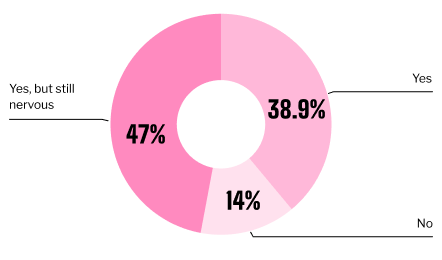
Workplaces should not require employees to disclose that they are a survivor. Whether or not to disclose is up to the employee. We asked this question to better understand the reality of disclosure.
Have you ever told a coworker that you are a survivor?

Would you have been more likely to tell a coworker you are a survivor if your workplace offered benefits or support specifically for survivors in the workplace?

Intersection of harm and work
WORK INTERFERENCE RESULTING FROM HARM
A harm-doer disrupts a survivor’s ability to obtain or maintain a job (which may or may not lead to being fired or forced to quit).
Top 3 types of work interference resulting from harm
62.6%
A harm-doer made me late to my job
52.1%
A harm-doer prevented or disrupted me from getting the education or training I needed for a job and/or to earn an income
52.1%
A harm-doer prevented me from going to my job
Other ways in which a harm-doer interfered with their ability to work:
Survivors mentioned that the emotional and mental impact that resulted from being subjected to harm interfered with their ability to work.
A harm-doer disclosed or threatened to disclose personal information
or spread lies to the survivor’s coworkers, employees, or potential employers.
A harm-doer prevented or disrupted the survivor’s ability to work by distracting, interfering, or otherwise making it difficult for the survivor to do their job.
IMPACT OF GENDER-BASED VIOLENCE ON JOB PERFORMANCE
Top 3 impacts of GBV on job performance
84.8%
I was unable to focus on my work or had a more difficult time focusing because of the gender-based violence I was subjected to
68.4%
I was less productive at work because of the gender-based violence I was subjected to
54.1%
I made (more) mistakes at work because of the gender-based violence I was subjected to
In addition to the impacts listed above, survivors also mentioned being subjected to the following types of harm that negatively impacted their job performance:
The mental health consequences of harm impacted survivors’ ability or motivation to work well.
The physical injuries that resulted from harm impacted survivors’ job performance, ability to work well, or ability to work altogether.
“The physical injuries caused by my husband made it hard for me to work effectively, such as moving and lifting objects.”
JOB/INCOME LOSS DUE TO GENDER-BASED VIOLENCE
Top 3 impacts of GBV on job, income, and career opportunities
56.9%
I lost income because of the gender-based violence I was subjected to
34.2%
I was forced to quit my job because of the gender-based violence I was subjected to
28.2%
I was passed over for a promotion and/or raise because of gender-based violence I was subjected to
Survivors shared the following additional experiences related to job or income loss due to the GBV that they were subjected to:
The emotional, social, and/or mental toll resulting from harm impacted the survivor’s ability to find or maintain a job.
The survivor was subjected to or threatened with disciplinary action due to the consequences of GBV.
“I lost work due to years of PTSD and the mental health impact of DV survivorship.”
Survivors also talked about how the intersections of harm and their immigration status impacted their job retention or income loss.
WORKPLACE ECONOMIC ABUSE
Top 3 instances of economic abuse in the workplace
33.9%
I have been asked to do things that are not part of my job description
32.9%
I was not allowed to access benefits like health insurance or vacation time for the first 1-6 months of the job due to my employer’s policies
32.6%
My coworkers and I are not allowed to talk to each other about how much money we make or our benefits
Intersecting harm
Survivors of GBV often experience multiple, interrelated forms of harm. We analyzed the intersections of the four primary harm constructs discussed in this section – work interference resulting from harm, impact of GBV on job performance, job/income loss due to GBV, and workplace economic abuse.
89.3%
Of survivors who were subjected to work interference also reported that being subjected to GBV had an impact on their work performance.
92.6%
Of survivors who were subjected to work interference also reported job or income loss as a result of GBV.
89.1%
Of survivors who were subjected to economic abuse at the workplace also reported that being subjected to GBV had an impact on their work performance.
80.3%
Of survivors who were subjected to economic abuse at the workplace also reported job or income loss as a result of GBV.
89%
Of survivors who reported being subjected to sexual assault/ harassment/discrimination at work also reported that being subjected to GBV had an impact on their performance.
81.7%
Of survivors who reported being subjected to sexual assault/ harassment/discrimination at work also reported job or income loss as a result of GBV.
TYPES OF WORK HARM BY JOB SECTOR
| Job Sector | Sexual assault/ harassment | Work-related economic abuse by harm-doer* | Harassment /harm by HD* | Work Interference | Impact on performance | EA at workplace | Job/ income loss | Economic abuse | |
| Hospitality | 54% | 43% | 65% | 85% | 80% | 69% | 69% | 87% | |
| Care work | 35% | 38% | 55% | 78% | 67% | 58% | 52% | 82% | |
| Professional services | 60% | 43% | 71% | 91% | 89% | 79% | 75% | 85% | |
| Healthcare | 45% | 44% | 69% | 85% | 81% | 70% | 66% | 88% | |
| Education | 41% | 30% | 55% | 84% | 83% | 63% | 60% | 77% | |
| Goverment | 52% | 50% | 75% | 88% | 90% | 69% | 71% | 88% | |
| Agriculture | 43% | 42% | 54% | 74% | 74% | 64% | 62% | 88% | |
| Sex work | 84% | 49% | 73% | 87% | 87% | 84% | 80% | 87% | |
| Non-profit | 50% | 36% | 72% | 83% | 85% | 64% | 58% | 82% | |
| Other | 64% | 67% | 67% | 78% | 74% | 65% | 60% | 88% |
The experiences outlined in this section detail specific types of harm survivors were subjected to at the workplace, including harm by a manager, harm by a coworker, and sexual assault/harassment.
HARM BY A BOSS OR MANAGER
The most common harm that survivors brought up was being subjected to verbal or emotional abuse
by their boss/manager, such as being shamed, gaslighted, or smeared.
Having a boss or manager who did not believe them, belittled/dismissed the survivor’s harm, or victim blamed them was also very common.
Survivors also mentioned being directly harassed, assaulted, abused, or physically harmed by
their boss.
Many survivors brought up having a boss/manager who condoned harm at the workplace, did not address harm, or did not set up processes for accountability.
HARM BY A COWORKER
Has a coworker ever done anything that caused you further harm? If so, what was it?
In addition to being subjected to harm by their bosses, many survivors said that their coworkers caused them further harm – although to a lesser extent than those who reported harm by their boss/manager.
The main type of harm survivors were subjected to by their coworkers was emotionally abusive behavior (e.g., bullying, criticism, judgment, mockery, etc.).
“One coworker told me the “situation created” by another coworker sexually assaulting me was “making it awkward” for everyone else.”
Survivors were also subjected to sexual assault, harassment, and other forms of physical violence and were threatened or intimidated by their coworkers.
Survivors had coworkers who were racist, sexist, misogynist, and transphobic.
SEXUAL ASSAULT & SEXUAL HARASSMENT
Top 3 instances of sexual harassment / assault / discrimination at work
52.5%
I was sexually harassed by a customer/client/patient/ business partner
50.5%
I was sexually harassed by a coworker(s)
40.6%
I was sexually harassed by my boss or manager
DISCRIMINATION/HARASSMENT/ASSAULT BY DEMOGRAPHICS
| Source of discrimination | Race | Gender | Sex | Disability | Immigration |
| By a boss or manager | 13.9% | 10.6% | 9.1% | 10.3% | 7.1% |
| By a colleague or a oworker | 7.2% | 15.0% | 14.2% | 8.7% | 5.2% |
| By a customer or client | 9.4% | 0.8% | 0.6% | 0.5% | 0.9% |
| Never experienced | 39.3% | 40.2% | 51.3% | 61.1% | 80.4% |
| By a boss or manager AND by a colleague or coworker* | 7.23% | 9.2% | 6.2% | 8.3% | 1.7% |
| By a boss or manager AND by a colleague or coworker AND by a customer or client** | 16.8% | 18.7% | 13.6% | 8.1% | 3.0% |
| By a colleague or coworker AND by a customer or client* | 3.7% | 3.4% | 2.9% | 1.4% | 0.9% |
| By a boss or manager AND by a customer or client* | 2.5% | 2.3% | 2.0% | 1.7% | 0.8% |
Survivors also spoke about the following types of discrimination, harassment, assault, or tokenism that survivors have been subjected to based on their immigration, disability, race/ethnicity, gender, and sexuality, survivors spoke about the following types of discrimination that they were subjected to in the workplace:
Survivors were discriminated against due to their familial status
(e.g., having children) or relationship status (e.g., single parent).
Survivors experienced discrimination related to being a survivor and spoke about how this compounded the effects of the harm as survivors.
Survivor were subjected to classism due to having a lower socioeconomic status or for being unemployed.
“Working in social services, I feel like my identity as a survivor has been tokenized. It’s always “we value your opinion as a survivor” and then [they do not] value my opinion or shut me down.”
“[I experienced] [h]arassment and
verbal abuse by [my] manager because I was afraid to speak up for myself due to my past life of being bullied, threatened, belittled, demeaned, etc. when I was sexually exploited.”
UNIQUE CHALLENGES IN DEALING WITH HARM
Throughout the survey, certain subgroups of survivors outlined the unique challenges that they faced in their ability to deal with the harm due to different aspects of their professional or personal life circumstances. In this section, we outline some of these challenges.
Survivors who worked in the field of GBV spoke about the unique challenges they face at work supporting other survivors while they themselves are still struggling or trying to heal.
“Although we work in this field and are passionate about helping survivors, they [employers] also need to use traumainformed care with staff.”
“I could not focus at all and lost my entire year and fellowship as a grad student.”
“Part of the violence was not allowing me to advance to my PhD and sabotaging important milestones for advancement to graduation.”
“I have a physical disability related to all of this, which worsened as the violence and lack of support worsened.”
The themes outlined below in this section detail how the consequences of being subjected to harm, both outside and within the workplace, impacted survivors’ job performance and ability to form relationships with others in the workplace.
UNFOCUSED
The most common response for how being subjected to GBV impacted survivors’ ability to focus at work was the mental health impacts that resulted from the harm. The main mental health impacts that survivors mentioned were:
Depression, anxiety, and stress
Trauma/PTSD, particularly due to having flashbacks and panic attacks at work
“I developed PTSD – this makes working really difficult to learn new
concepts / engage with colleagues.”
“[I] [h]ave often made mistakes at work because of mental health concerns (depression, anxiety, forgetfulness) caused by the trauma and overwhelm of being a single parent of two while healing.”
“My mind has often been overwhelmed with ruminating thoughts and heightened anxiety
that distracted my productivity.”
Survivors discussed an inability to focus as a result of feeling fearful or due to constantly thinking about the harm while they were at work. Specifically, survivors described:
Unable to focus due to the harm-doer constantly calling, texting, or otherwise contacting survivors while they were at work.
Being on high alert, hypervigilant, paranoid, in survival mode, or triggered.
Constantly thinking about the harm, harm-doer, and/or how to deal with the consequences from the harm.
Feeling fearful that their harm-doer would show up at the workplace or because their harm-doer worked at the same place.
Being concerned about personal or family’s safety related needs.
MORE MISTAKES
Survivors reported making more mistakes at work due to the GBV they were subjected to, as outlined below.
Made more mistakes as a result of having difficulties focusing, concentrating, or paying attention.
Made more mistakes due to the impact of the harm on their mental health – primarily, trauma, anxiety, depression, and stress.
“From the concussions he gave me, I started to mix up words and numbers, etc.”
Made more mistakes due to being tired from a lack of sleep related to harm or other sleeping issues related to the harm.
Everyday, small tasks became more difficult or took longer to complete as a result of being subjected to harm.
The general emotional impact of harm and the emotional or verbal abuse itself were described as reasons for making more mistakes.
LESS PRODUCTIVE
Survivors expanded on how GBV impacted their ability to be productive at work, as detailed in the themes below.
“I stopped answering my phone at work due to my fear of it being him or someone he was attached to. My productivity diminished because my job duties were phone-based.”
Survivors mentioned they had difficulty concentrating at work or it took them longer to complete a task.
Survivors said they were less productive due to being mentally consumed by thoughts related to the harm/abuse.
Survivors also said that being fearful, hypervigilant, on high alert, and scared, particularly related to fears that the harm-doer would show up at the workplace, impacted their ability to be productive at work.
Survivors felt exhausted, mostly from being unable to sleep as a result of the harm or due to being intentionally kept awake by their harm-doer .
Survivors reported being less productive at work due to their harm-doer constantly texting or calling them during work hours.
“I was living in a state of fight-or-flight. My mind was too preoccupied with the issues going on in my personal life, so I could not perform at my highest standards.”
RELATIONSHIP WITH BOSS
Survivors said that being subjected to harm both outside of and in the workplace impacted their relationship with their boss or manager.
“My bosses had toxic masculinity and made me feel unsafe at times. I would rather not interact with them.”
Survivors said that the consequences of being subjected to harm also impacted their relationship with their boss. For instance, many survivors spoke about how the relationship with their boss was impacted due to their attendance or performance at work, which suffered from the harm they were subjected to.
Other survivors mentioned that it was difficult for them to form relationships at work,
primarily due to the trauma that resulted from the harm.
A group of survivors mentioned that they did not want to disclose survivorship to their boss or otherwise did not trust their boss.
RELATIONSHIP WITH COWORKERS
Being subjected to harm also impacted survivors’ relationships with their coworkers or other colleagues at work. The reasons that survivors listed for their relationships with their coworkers being negatively impacted were very similar to those listed for their relationship with their boss being negatively impacted.
Relationship with coworkers was impacted because it was difficult for the survivor to form relationships as a result of the harm they were subjected to.
Relationship with coworkers was impacted because of the trauma that resulted from harm.
“I often wasn’t allowed to make friends at work. He wanted me [to be] very isolated but needed me to work so he would have money. I think they probably thought I was stuck up or something, but I was scared I would get them hurt if we were ever friendly.”
“Like I mentioned before, I wasn’t allowed to speak to other men and I worked with many of them. I had to be cold-shouldered to them and that wasn’t like me at all. I was rude and people didn’t like me, but it was a role I had to play to avoid my harm-doer.”
Workplace benefits, support, & needs
SUPPORT FROM BOSSES
This section focuses on the different types of support and resources that survivors need to feel safe in their workplaces. Below, survivors describe the different things that a boss or manager has done in the past that supported them as survivors.
Having a boss/manager who allowed them to take time off as needed, particularly being able to take time off to deal with consequences of harm with no penalty.
A boss or manager provided them with relevant resources or referrals to services, particularly those pertaining to counseling or mental health.
Survivors also talked about the importance of survivor-centered policies, training, or other survivor-friendly resources that bosses/managers implemented at the workplace.
A group of survivors said they found it helpful when their boss/manager limited their interactions with a harm-doer or held the harm-doer accountable for causing harm in the workplace (e.g., firing, reassigning harm-doer).
[They] ignored harm-doer’s harassing emails and phone calls and didn’t blame me for it.”
I’ve had a manager pay me almost two weeks early because she knew what I was going through not just emotionally but financially as well.”
[My boss has] gone to court with me for a protection order [and]
gone to court with me while my abuser was being charged with
assault charges.”
SUPPORT FROM COWORKERS
Survivors also shared the types of behaviors and support they found helpful from their coworkers. These were very similar to what survivors said they found helpful from a boss/manager:
Coworkers who were flexible, understanding, and accommodating to the survivor’s needs at work.
Coworkers who supported the survivor with their safety and provided specific safety/security measures.
Coworkers who supported and advocated for the survivor at work, including celebrating the survivor for their accomplishments and
advocating for the survivor when a client submitted a complaint about them.
Coworkers who helped the survivor find job opportunities.
HOW EMPLOYERS CAN SUPPORT SURVIVORS
Survivors had many ideas for how employers can support them at work. Most of the themes that emerged from this question pertained to workplace recommendations. The top workplace recommendations were
as follows:
Employers should provide different types of resources and support to address multiple needs,
including financial support, protections against retaliation/job loss, childcare support, and support groups for survivors.
Employers should advance emotional wellness and mental health support in the workplace, primarily by providing or facilitating access to mental health services such as counseling and therapy.
Employers should adopt gender-based violence training and be better at spotting signs of GBV.
Employers should create and lead workplaces and workforces that are trauma-informed.
OTHER THINGS EMPLOYERS SHOULD KNOW
Survivors were asked about other things that they would like employers to know. Most of the themes that emerged in this question were very similar to those that emerged in the “How to Support Survivors” question above. These included the following:
Employers should have a supportive attitude
– being caring, patient, and thoughtful, among other attitudes
Employers should have a minimum understanding of harm, healing, and what it means to be a survivor.
Employers should have a better understanding of safety and support survivors in being safe at the workplace.
Employers should know that some survivors are
uncomfortable disclosing that they are survivors or that they have experienced harm, so they should not be probing them.
Survivors reported the following experiences related to taking time off to deal with the consequences of harm:

74.4%
of question respondents indicated experiencing at least one of the behaviors listed here
12
vacation
days
11
sick
days
Average number of days survivors had to take off from work to deal with the consequences of GBV.
Survivors also described how being unable to take leave impacted their family life or other family matters:
Not having access to leave impacted the survivor’s family life,
such as not being able to spend time with their children, being unable to attend important life events, or otherwise straining family dynamics.
Due to not having leave, survivors were unable to find someone to take care of their children. Relatedly, survivors’ childcare needs impacted their ability to take time off or to work, or required them to depend on their harm-doer to take care of the children.
“Asking a manager for leave and their knowing what was up and saying that I did not qualify for a type of leave because of the type of violence I experienced – it’s like if you share with employers what you are going through, it can be almost as bad as if you never told them. It’s so hard to navigate.”
SURVIVOR-CENTERED WORKPLACE BENEFITS
Did your job(s) in the sector you selected offer benefits or support specifically for survivors?

What benefits or support did your job offer survivors?
Only a small number of survivors mentioned that they had access to benefits or support that were specific for survivors or designed to
meet their individual needs.
Paid leave, including leave with guaranteed right of return.
Different types of financial
support, including loans, one-time cash assistance, and emergency funds.
Different types of support to deal with/address the consequences of harm, such as offering “safe days” and access to DV services.
Support with basic needs, such as food, transportation, and personal hygiene.
Support with costs or access to long-term or temporary housing.
TOP 3 WORKPLACE BENEFITS THAT WOULD HELP SURVIVORS STAY EMPLOYED AND/OR WORRY LESS AND FOCUS MORE ON THEIR JOB
95.5%
A fund that you could apply for in the case of an emergency that you would not have to pay back.
92.8%
Paid leave that you can use to deal with the consequences of gender-based violence, like relocate, go to therapy, or go to court without having to worry about losing your job.
92.3%
A program where your employer matches a certain % of the money you save each month.
Stay in the loop with Survivors at Work
SIGN UP FOR OUR NEWSLETTER
DOWNLOAD REPORTS

EXECUTIVE SUMMARY
Review key findings about challenges survivors face in the workplace — with actionable solutions
DOWNLOAD REPORT

FINDINGS ON WORKPLACE EXPERIENCES
Dive into the data behind our research into survivors’ employment & workplace needs
DOWNLOAD REPORT

Data-Driven Insights for Employers
Explore 9 benefits & policies that define survivor-supportive workplaces
DOWNLOAD REPORT
A Practical Approach to Policy Change
Explore 6 actionable policy recommendations to support survivors in the workplace and build long-term safety
DOWNLOAD REPORT
Thank you to every survivor who participated:
We are immensely grateful to the 2,400+ survivors and 34 focus group participants whose valuable expertise and insights guided our work and shaped the development of these resources.
ADDITIONAL RESOURCES
model safe leave policy
Understand State Laws impacting survivors
Partner with FreeFrom
CONTACT US
Ending GBV: An Economic Issue That We All Have a Role to Play in
CONTENT WARNING
Please be advised that these resources contain mentions of gender-based violence (GBV), intimate partner violence (IPV), domestic violence, sexual assault and harassment, economic abuse, trauma, court appearances, police, workplace discrimination, job loss, and physical harm. As you engage with these resources, we encourage you to take care of yourself in whatever way that is comfortable to you and to seek support as you see fit